Why Wildfire Ash Reduces Solar Output and When to Clean
Wildfire ash isn't like ordinary dust. It's fine, often alkaline, and it clings to glass, especially when morning dew turns a dry film into a paste. Even a thin, even layer keeps sunlight from reaching the cells. And because the cells in a panel are wired in series, uneven shading can drag output down by more than the dirty patch alone would suggest. Understanding that difference is the first step in wildfire ash removal from solar panels.
Keep the numbers in perspective. A Nature Communications study found that smoke-linked losses of solar resource stay modest away from the immediate area around active blazes, though output at California plants near fires in 2020 dropped by roughly 11 to 17 percent compared with low-smoke years. That figure describes utility plants close to fires, not a rooftop in Stockton, so read it as a ceiling on the smoke problem, not a forecast. For ash that actually settles on the glass, a laboratory study on ash deposition reported close to a 30 percent hourly energy reduction once accumulation reached about 0.4 mg per square centimeter. It's a controlled lab result, but it shows why a visible gray film deserves attention.
So when is wildfire ash removal from solar panels warranted? A simple rule works: if you can see a film, streaking, or drifts of ash on the glass, or if your monitoring app shows production lagging behind a comparable clear day, it's time. If the panels look clean after a rain and output is normal, skip it. The U.S. Department of Energy's guidance on photovoltaic hardening for wildfire resilience is direct on this point: when modules are undamaged but covered in ash, the owner should remove it to restore working efficiency.
Most owners ask about rain first. A good soaking can wash off some loose ash, particularly on steeper pitches, but it often leaves a streaky residue and rarely clears the lower edge of the panel, where grime collects. In the Central Valley, where rain can be weeks away during fire season, waiting for the sky to do the job usually means weeks of lost production.
When to Schedule Cleaning: Timing After Ashfall Stops
Timing matters more than speed in wildfire ash removal from solar panels. Clean while the fire is still active or the smoke is still dropping ash, and the next morning you'll be looking at panels coated all over again. The best window opens once ashfall has stopped and local air quality has recovered enough to work outdoors comfortably.
In practice, check the Air Quality Index for Stockton before anyone climbs onto a roof. Hazardous air is a reason to postpone, whether the person on the roof is you or a technician. Once air quality improves and you no longer see fresh ash settling on cars and patio furniture overnight, you have a sensible window to book.
Many guides suggest scheduling a professional cleaning within a week or two of visible ash fallout, and that's a reasonable target. The longer ash sits, the more it can bond to the glass with dew and humidity, and the more production you lose on every sunny day in between. If a second smoke event is forecast, though, it can make sense to wait for it to pass rather than pay for two visits.
A few signs that it's time to call:
- A visible gray or tan film, or ash drifts along the lower frame edge
- Production noticeably below a comparable clear day on your monitoring app
- Ash visible on nearby surfaces such as cars, patios and window sills
- A smoke event that has ended and an AQI that has returned to a safe range
Commercial owners with larger arrays should also keep a dated record of the ash event and the cleaning that followed. That documentation can help if you later discuss performance with an installer or insurer.
Safety First: Protective Gear, Roof Access and Warranty Terms
Ash isn't harmless housekeeping dirt. It carries fine particles and irritants, and cleanup calls for real respiratory protection. Guidance drawn from the CDC points to a NIOSH-approved respirator, not a cloth or surgical mask, because ordinary masks don't filter fine ash. Add gloves, long sleeves and eye protection, and keep the ash off your clothes and out of the house afterward.
Roof access is the other hazard, and it's the main reason many Stockton owners would rather not do this themselves. Wet glass and wet ash are slick, panels can be hot by midday, and a fall from a roof is a serious injury. Without fall protection and experience working at height, this is a job for a licensed, insured technician. Best Solar Panel Cleaning's crews are licensed and insured, and the service is available around the clock, so you can book without rearranging your schedule around a roof visit.
Two shortcuts deserve a firm warning. Don't dry-wipe the panels with a rag, broom or leaf blower. Ash is abrasive, and dragging it across the glass can scratch the anti-reflective coating that helps the panels capture light. Don't use a pressure washer either. The Department of Energy advises against high-pressure hoses because they can damage the glass surface of the modules.
Finally, read your warranty before any wildfire ash removal from solar panels begins. Manufacturers differ on which methods and chemicals they allow, and some installers have their own terms. Look up your panel manufacturer's maintenance guidance and keep a copy with your records. A gentle, low-pressure, pure-water approach is the kind of method most manufacturers' care instructions favor, but confirming your specific terms takes two minutes and protects your investment.
Step-by-Step Chemical-Free Pure-Water Ash Removal
What you need before step 1:
- A NIOSH-approved respirator, gloves, eye protection and long sleeves
- A pure or deionized water supply
- A soft-bristle brush or soft microfiber tool on an extension pole
- Safe, stable access, or a professional to do the roof work
- Confirmation that the panels have cooled and ashfall has ended
Step 1: Confirm the conditions
Check the AQI and your local forecast. Go ahead only when ash has stopped falling and the air is safe to work in. Early morning or late afternoon is best, since cool glass lets the water work gently without drying into spots.
Step 2: Suit up and secure the area
Put on your respirator, gloves and eye protection before you disturb any ash. Close nearby windows and move patio items so you don't spread ash around the property.
Step 3: Do not dry-wipe
Resist brushing or blowing off the loose layer. Dry contact is what scratches the coating. Start with water, never friction.
Step 4: Pre-rinse with a low-pressure pure-water flow
Let a gentle flow of pure water run over the glass from the top of the array downward. This floats the loose ash off the surface and carries it away without grinding it into the glass. Pure water leaves no mineral residue as it dries, which is why it's the foundation of a soap-free method.
Step 5: Agitate lightly with a soft brush
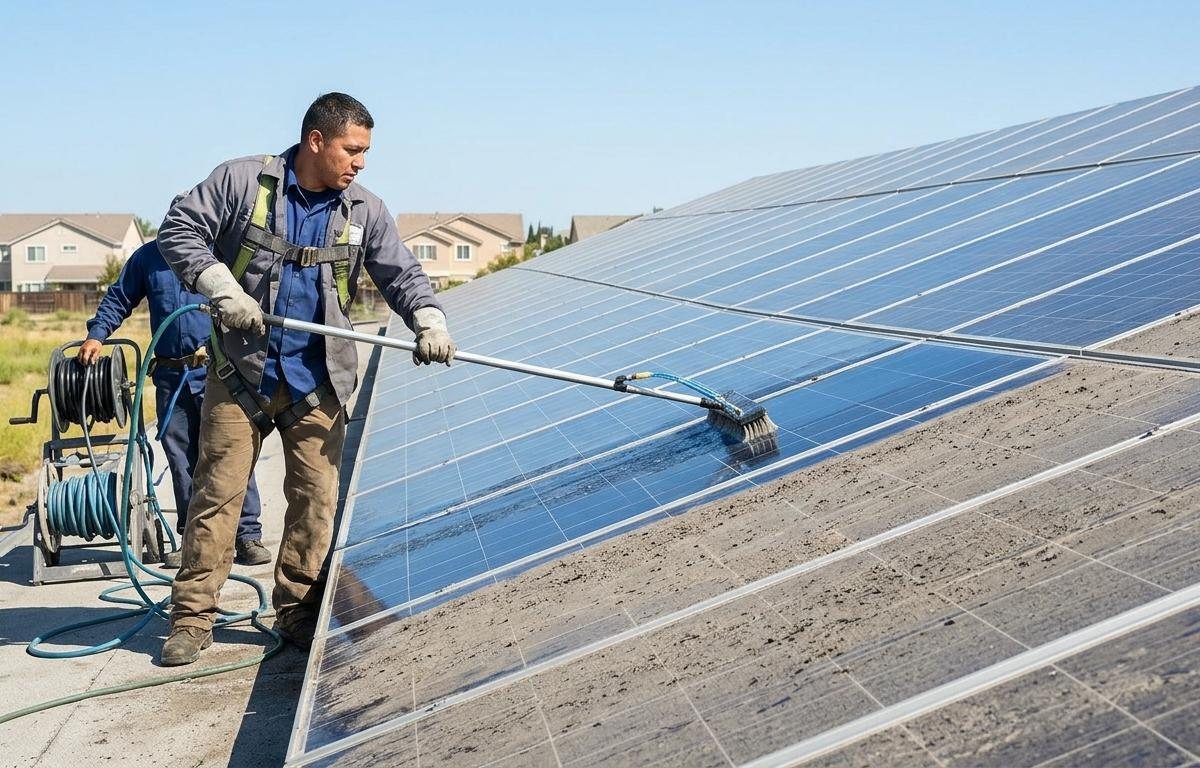
For the film that remains, use a soft-bristle brush with a continuous pure-water feed, working in light, overlapping passes. Let the water do the lifting. Avoid abrasive pads, hard-edged squeegees, and anything that adds pressure.
Step 6: Rinse and inspect
Finish with a final pure-water rinse so no film or streaks remain. Check the lower edge and frame corners, where ash tends to collect, and look for any cracks or damage to flag for your installer.
Step 7: Let the panels dry and check output
Pure water dries without spots. Compare your production to a similar clear day afterward. That's the real test of whether the job restored performance.
This is the approach Best Solar Panel Cleaning takes on every visit. The company's pure-water system cleans without soaps or detergents, which protects panel coatings and leaves no residue behind. Some agency guidance does mention soap and water as an acceptable option, but a soap-free pure-water rinse does the same job and removes the question of detergent film altogether.
Runoff, Disposal and Window Cleaning, Plus When to Call a Pro
Ash-laden rinse water from wildfire ash removal from solar panels is easy to overlook. Pure water carries no detergents or chemicals, so the runoff is simply water plus the ash it carried, a real advantage over soap-based cleaning. Still, wildfire debris can contain contaminants, so don't direct a heavy slurry into storm drains or onto a vegetable garden. Let the water flow across a lawn or planted area where it can soak in, collect any thick sediment, and follow local solid-waste guidance for disposal rather than flushing it into gutters.
Ash doesn't stop at the roofline. It settles on windows, sills and screens, and a smoke event typically leaves the whole property filmed over. Because Best Solar Panel Cleaning also offers window cleaning, one visit can cover both the panels and the glass at ground level. That saves a second appointment and leaves the whole property looking clean.
So should you do it yourself or call a pro? DIY can make sense if your panels sit on a low, safely reachable roof, you have proper respiratory protection, and you're comfortable with pure-water, no-pressure methods. It makes less sense when the roof is steep or high, when the array is large, or when you simply would rather not breathe ash. Professional cleaning typically runs in the low hundreds of dollars nationally, a modest cost against weeks of lost production on a system that represents a significant investment.
If you're in Stockton and want the ash gone without the ladder, the air-quality worry or the warranty guesswork, book a visit with our licensed and insured team at Best Solar Panel Cleaning. You can also explore our chemical-free solar panel cleaning approach or add window cleaning to the same appointment, and we'll restore your panels with nothing but pure water.