What Deionized and Distilled Water Are and How Each Is Made
Both deionized and distilled water count as "pure," but they get there by different routes. That difference matters when you weigh deionized vs distilled water for solar panels, because the water dries on glass in the California sun.
Distilled water is made by phase change. You boil the water, catch the steam, and condense it back into liquid. Most dissolved minerals, salts and particulates stay behind in the pot. Alliance Chemical's explanation of how deionized water is made covers what each process removes and how.
Deionized (DI) water is made by ion exchange. Water flows through resin beds that trade out charged particles, the ions of salts like calcium, magnesium and sodium, for hydrogen and hydroxide, which recombine into water. The minerals are pulled out chemically instead of boiled away. The result has essentially no dissolved ionic content.
Neither process is magic, and each has a blind spot. Distillation depends on boiling, so some volatile organic compounds with boiling points below water's can evaporate along with it and end up in the finished product, a limitation noted in ChemiTek's guide to water for cleaning solar panels. Deionization targets ions. It strips minerals very well but doesn't treat every non-ionic contaminant the same way. Keep that split in mind, because everything below builds on it.
Deionized vs Distilled Water Side by Side: Residue, Compounds and Trade-offs
When it comes to deionized vs distilled water for solar panels, the question is simple: what's left on the glass after the water evaporates? Both options are chosen because they leave little or nothing behind, though each has its own strengths.
Deionized water's big advantage is mineral removal. With its mineral ions exchanged out, it dries on glass without the white scale and spotting that ordinary water leaves. Many installers and cleaners treat it as the standard for spot-free results, and Solarstan's overview of deionized water for solar cleaning makes that case directly. It suits routine washing, where a clean, streak-free rinse is the goal.
Distilled water's big advantage is that the process physically separates water from nearly everything non-volatile. It's a perfectly reasonable choice for small, occasional jobs, and some sources argue it can sometimes be purer than deionized water. The catch: it can carry over those low-boiling volatile compounds, and making it at scale is slow and energy-hungry, so rinsing a whole array with it isn't realistic.
Industry opinion is split on which is "better," and an honest comparison should admit it. This is a trade-off, not a settled ranking. If you're worried about dissolved minerals drying into scale, both do the job. If you care about volume, convenience and consistent spot-free drying across an entire roof, deionized water is usually the more practical tool. If you're rinsing one small panel by hand and happen to have a jug of distilled water, that works too.
Neither one cleans by itself. Pure water is a rinsing and dissolving medium. It works best with soft brushing and good technique, as shown in this step-by-step solar panel cleaning workflow.
Why Minerals Leave Spots: TDS Ranges and Hard-Water Deposits on Panels
Tap water looks clear, but it carries dissolved minerals and salts. When a droplet sits on a hot panel and evaporates, the water goes and the minerals stay. After enough cycles, that residue builds into limescale and stain deposits on the glass. ChemiTek describes exactly this: once dry, the minerals form limescale deposits on panel glass.
The yardstick here is TDS, or total dissolved solids, measured in parts per million (ppm). The more dissolved solids in the water, the more residue it leaves when it dries. Sources don't agree on one cutoff, so think in ranges rather than a single magic number:
- One cleaning guide notes that if tap water has a TDS above roughly 50 ppm, calcium carbonate deposits form as the water evaporates.
- Another source sets the spot-free target much lower, saying water should read below about 10 ppm for truly spot-free results on windows and solar panels.
- A vendor-sourced claim says many module manufacturers specify cleaning water below 50 ppm for routine washing. Since that comes from a secondary source, check your own module datasheet before relying on it.
In practice, under 10 ppm is the safest zone for a spot-free finish, and readings climbing past 50 ppm are where visible deposits become likely. Research on utility-scale soiling points the same way, noting that solar facilities use demineralized or distilled water to wash panels and avoid mineral scale, as described in a UNLV thesis on panel soiling.
Why it matters: dirty or scaled glass costs you production. One guide puts soiling losses at roughly 15 to 30 percent of output, though that figure comes from a guest post, so treat it as indicative, not guaranteed. The takeaway isn't to chase a number. Residue you leave behind can become the next layer of dirt.
How to Choose the Right Water and Test Your Own TDS, Including Stockton Tap Water
Choosing between deionized vs distilled water for solar panels comes down to a few concrete criteria, not a blanket "best."
Match the water to the job. A full array needs more spot-free water than jugs of distilled water can realistically supply, so a deionization setup is the practical route. For one or two easy-to-reach panels, a few gallons of distilled water can do it.
Check the TDS, don't guess. A handheld TDS meter is cheap and easy to find, and it takes seconds to use. Fill a clean cup, dip the probe, read the number. Then test your final rinse water the same way. A reading in the low single digits means you're in good shape for spot-free drying. If it's climbing toward 50 ppm or beyond, expect visible residue.
Test your Stockton tap water specifically. Local water hardness varies, so don't assume your number. Central Valley tap water can carry meaningful dissolved minerals. Measure it yourself with a TDS meter and compare it against the city's published water quality report. Whatever you find, water straight from the hose is the option most likely to leave scale on your glass, a risk also covered in Microgrid Media's discussion of cleaning panels with tap water.
Consider the whole process. Water quality is only one variable. Brushing, timing and avoiding harsh detergents all affect the outcome. Panels in Stockton also face seasonal grime, and after wildfire season ash can add another layer. Our guide to wildfire ash removal from solar panels in Stockton explains how to handle it safely.
Think about safety. Climbing onto a roof with wet, slippery panels carries real risk, and impure rinse water can undo your effort. For many homeowners, the sensible move is to hand the job off.
Chemical-Free Pure Water Cleaning from Best Solar Panel Cleaning
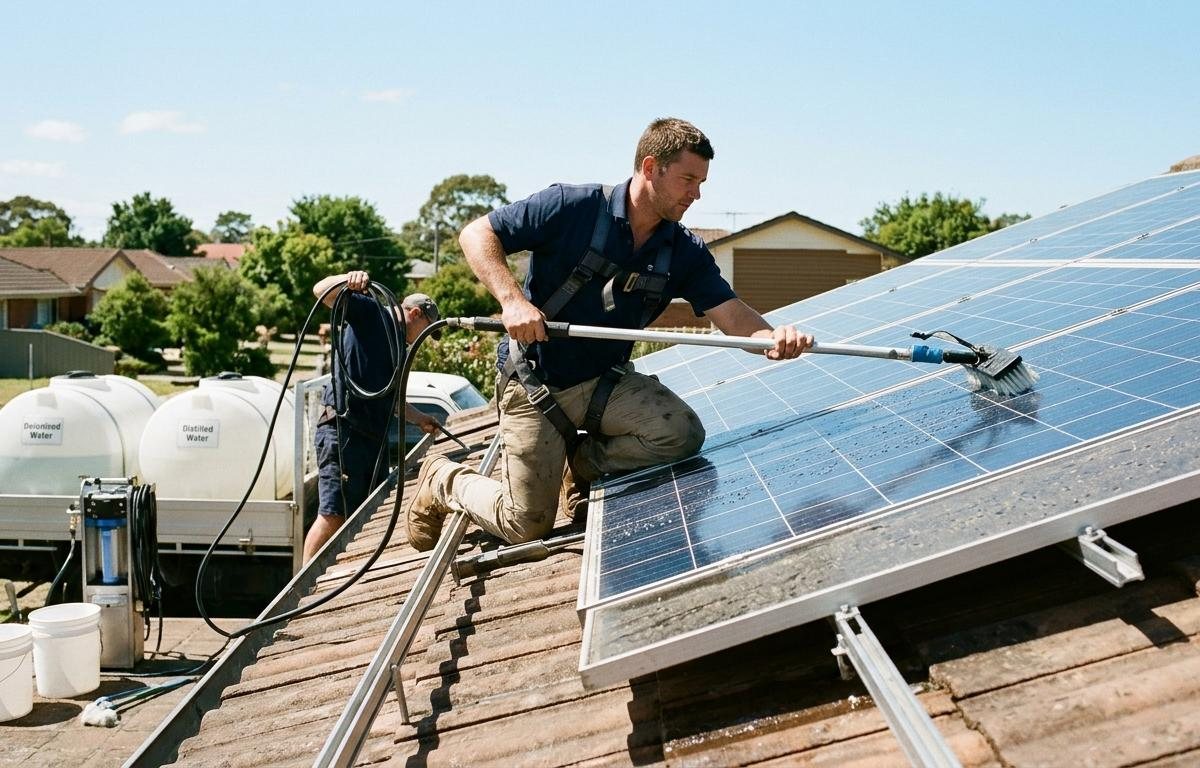
Best Solar Panel Cleaning is a professional solar panel cleaning service based in Stockton, California, built on the principle this article describes: pure water does the work, and no soaps or detergents are needed. Our pure water system lifts dirt and residue without leaving a film behind. That protects your panels' coatings and the environment while restoring the clean glass your system was designed to work through.
Because we bring our own purified water, you don't have to wonder whether your tap water's mineral content will spot the glass, and you don't have to buy, test or manage deionization equipment yourself. You get a spot-free finish that dries clean, without the chemical residue detergent-based washing can leave.
Our technicians are licensed and insured, and we operate 24/7, so scheduling fits around your life, not the other way around. We serve residential and commercial solar owners across Stockton who want to protect the efficiency and longevity of their investment. We also offer window cleaning for homes and businesses that want all their glass handled in one visit.
If you've been weighing deionized vs distilled water for solar panels for your own cleaning, here's the short version: both avoid the mineral spotting that ordinary tap water causes, and for an entire array, a purpose-built pure water system is the practical answer. If you'd rather skip the testing, the equipment and the ladder, contact Best Solar Panel Cleaning and we'll handle it with a chemical-free clean.