Why Solar Panels Streak: Minerals, Rain and Fast Evaporation
A streak is almost never dirt that got left behind. It's what's left of water that dried before anyone could wipe or rinse it off. Ordinary tap water carries dissolved minerals like calcium, magnesium and sodium. When a drop evaporates, those minerals stay put as a faint white ring, a spot, or a line where the water ran. Cleaning guides keep making the same point: tap water leaves lime and salt deposits that harden into stubborn streaks, while purified water dries without a trace.
Three things work together to create the marks you see:
- Hard water. The more dissolved solids in the water, the heavier the deposit it leaves.
- Rain. Light rain doesn't rinse a panel clean. It dampens the dust on the glass, then dries into muddy lines along the frame and across the surface. If you've ever wondered whether rain is enough to clean solar panels, you've probably already seen the answer: it helps with loose dust, but it often leaves its own streaks.
- Fast evaporation. Glass on a sunny day gets hot. Water sprayed onto a hot panel flashes dry before you can rinse it, so the minerals dry in place. Cleaning during the cooler parts of the day slows this down, and it's one of the simplest ways to prevent streaks.
In Stockton, summer afternoons make all of this worse. Panels baking in Central Valley sun can be too hot to clean properly by midday, and dust, pollen and agricultural residue cling to the glass between cleanings.
The good news: solar panel cleaning without streaks comes down to water and timing, not stubborn panels. Fix those two things and the glass comes up clear. If you want to know what separates one kind of purified water from another, our comparison of deionized vs distilled water for solar panels covers the details.
Step-by-Step: Streak-Free Cleaning with Pure Water
Pure water is the heart of solar panel cleaning without streaks. Water stripped of virtually all its mineral ions has nothing to leave behind as it dries. That's how we work at Best Solar Panel Cleaning: a pure water system, no soaps, no detergents, nothing to rinse off and nothing to leave a film. Here's how the process goes.
What you need before step 1: a source of purified water, a soft non-abrasive brush (ideally on a water-fed pole), a ladder or another safe way to reach the array, and a cool, shaded or overcast stretch of time.
Step 1: Check the panels and the conditions
Make sure the panels feel cool to the touch. Early morning, late afternoon or an overcast day works best. If the glass is hot, wait. Also look for cracks, loose wiring or damaged seals, and don't spray water at anything that looks compromised.
Step 2: Remove loose dust and debris
Start with a gentle pass to knock off leaves, bird droppings and loose grit. Dragging a dry brush over grit can scratch the glass, so wet the surface first and let the water carry the debris away.
Step 3: Wash with pure water and a soft brush
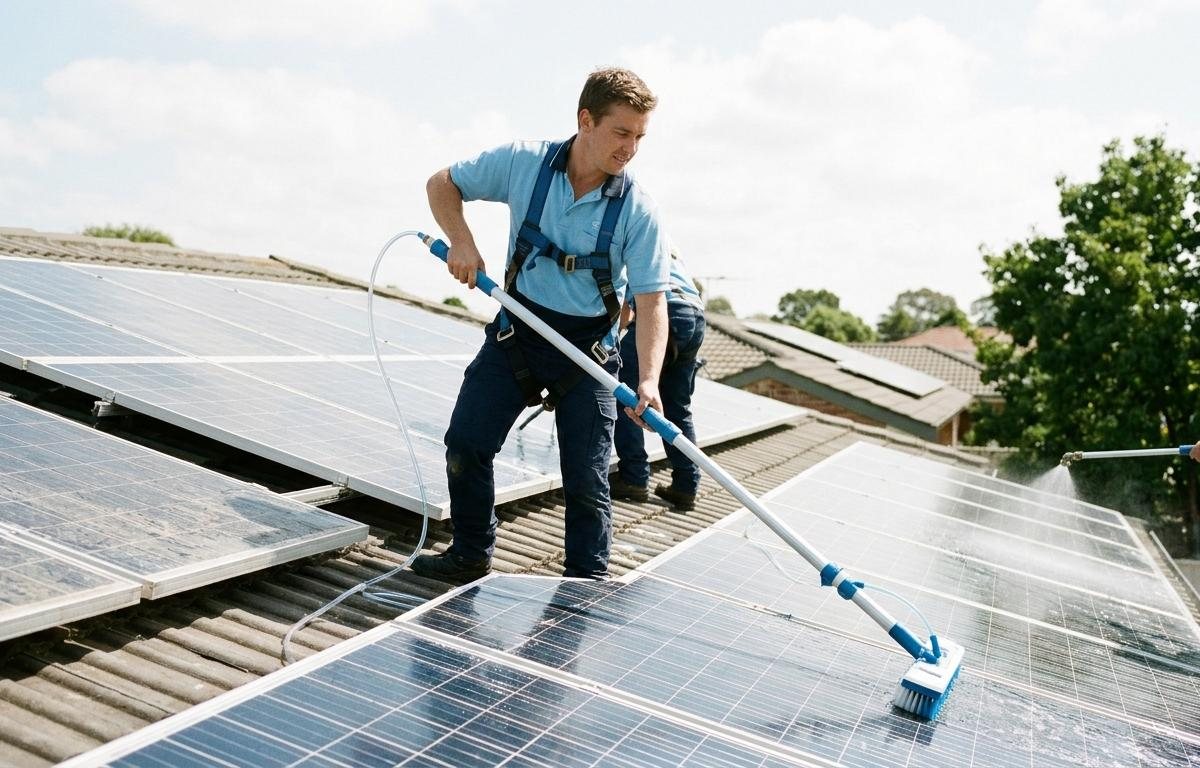
Work from the top of each panel downward, using the soft brush and a steady flow of pure water. Stubborn deposits loosen with patient, light agitation rather than pressure. A water-fed pole lets you brush and rinse in one motion, so the water never gets a chance to dry on its own.
Step 4: Rinse thoroughly
Give the whole panel a final rinse with pure water, again from top to bottom. Because the water carries no minerals, whatever dries on the glass leaves nothing visible.
Step 5: Decide whether to squeegee
Sources disagree here, but the answer is simple. With true pure water, you don't need a squeegee, since the water dries spot-free by itself. With tap water, a rubber squeegee in one smooth downward stroke can limit streaks, but that's a workaround for hard water, not a fix. If you do squeegee, use a clean, soft blade and never drag it across dry glass.
Step 6: Let the panels air dry and inspect
Step back and look at the glass from an angle. If it dries clear, you're done.
Tools, Timing and What to Avoid
The tool list is short: a soft, non-abrasive brush, a water-fed pole for reach, a supply of purified water, and, if you want one, a soft rubber squeegee. Many guides recommend this combination, and it's gentle enough to protect the anti-reflective coating on the glass.
Timing matters as much as tools for solar panel cleaning without streaks. Clean in the cool part of the day, out of direct sun, and skip windy days when dust blows back onto wet glass. Around Stockton, that usually means early morning, especially in summer.
Here's what to leave out of the toolkit:
- Pressure washers. The worry is high-pressure force against seals, frames and glass coatings. Panels are built to handle weather, not focused jets at close range, and the risk of damage isn't worth it.
- Abrasive pads and stiff brushes. These can scratch the surface and the coating, leaving a permanent haze that traps more dirt.
- Hot panels. Cold water on hot glass dries fast and streaks, and sudden temperature swings are bad for any glass.
- Harsh chemicals. Aggressive cleaners can degrade coatings and seals.
Then there's the question many owners ask: can I use soap or detergent? The advice out there is mixed. One DIY guide suggests a little mild soap for stubborn spots. Our position is simpler. Soap tends to leave a film of its own, which is exactly the kind of residue that causes streaks, so we skip it entirely. Pure water alone does the job, which is also why our service stays chemical-free and safe for panel coatings and the surrounding environment.
If you're weighing a do-it-yourself approach, the main trade-offs are reach, safety on the roof, and finding water pure enough to dry clean. You can start with this DIY cleaning overview, but be realistic about the ladder work involved.
Diagnosing Spots, Film and Residue on Your Panels
Not every mark on a panel is the same, and treating them all alike is how people end up scrubbing harder than they need to. Here's a practical way to read what you're seeing.
White rings and crusty spots. These are mineral deposits, usually from hard tap water or sprinklers hitting the panels. They tend to sit in the shape of a dried droplet. Repeated pure-water cleaning, with a little patience and gentle brushing, usually lifts them. Research on this topic notes that mineral residue can leave a film or spots on glass, which is why the water you rinse with matters so much.
Hazy film across the whole surface. A uniform cloudy look often comes from airborne grime, pollen or oily residue, or from leftover soap if a detergent was used before. A thorough pure-water wash typically clears it. If soap was the culprit, a few rinses with pure water gradually remove the film.
Brown or gray streaks running down from the top edge. This is usually dust that rain turned to mud, trapped along the frame and washed across the glass. Cleaning the frame edge carefully, not just the middle of the panel, keeps the same streak from coming back.
Dark patches and caked-on residue. Bird droppings, tree sap and, in wildfire season, ash can bake onto the glass. These need softening with pure water before any brushing. Our guide to wildfire ash removal from solar panels in Stockton explains how to handle that safely.
Marks that won't budge. If a spot survives repeated gentle cleaning, it may be etching, a change in the glass surface itself rather than something sitting on top of it. Stop scrubbing. More force won't help and may cause damage.
Why does any of this matter for output? Dust soiling is well documented. A study of dusty modules found losses in the range of 3% to 14%, and a broader review puts dust-related losses at roughly 15% to 20%. Streaks are a smaller part of that picture, but spots and film on the glass block light just as dust does. We'd rather you see that in context than hear an exact efficiency number nobody can back up.
When to Call a Professional in Stockton, CA
Plenty of homeowners can handle a light cleaning, and the answer to "can I clean solar panels myself?" is yes, with care. But some situations call for a professional:
- Roof access is risky. Steep pitches, two stories, or panels far from a ladder-safe edge are where most DIY accidents happen.
- The spots keep coming back. If you've rinsed, brushed and re-rinsed and the streaks return, the cause is probably your water supply or your technique, and fixing it takes the right equipment.
- You have a large or commercial array. Rows of panels on a business roof or ground mount take hours to clean properly, and getting solar panel cleaning without streaks across the whole system is hard without a water-fed pole setup and purified water on hand.
- You want to protect coatings and warranties. Chemical-free methods and soft tools keep the glass in good condition.
That's where Best Solar Panel Cleaning comes in. We serve residential and commercial solar owners across Stockton with a chemical-free pure water system that removes dirt and residue without soaps or detergents, which is why the glass dries clear instead of streaked. Our technicians are licensed and insured, and we operate around the clock, so we can schedule cleanings for the cool early hours when conditions are best.
If your panels are showing spots, film or stubborn streaks, get in touch and we'll get them back to a clear, even finish.