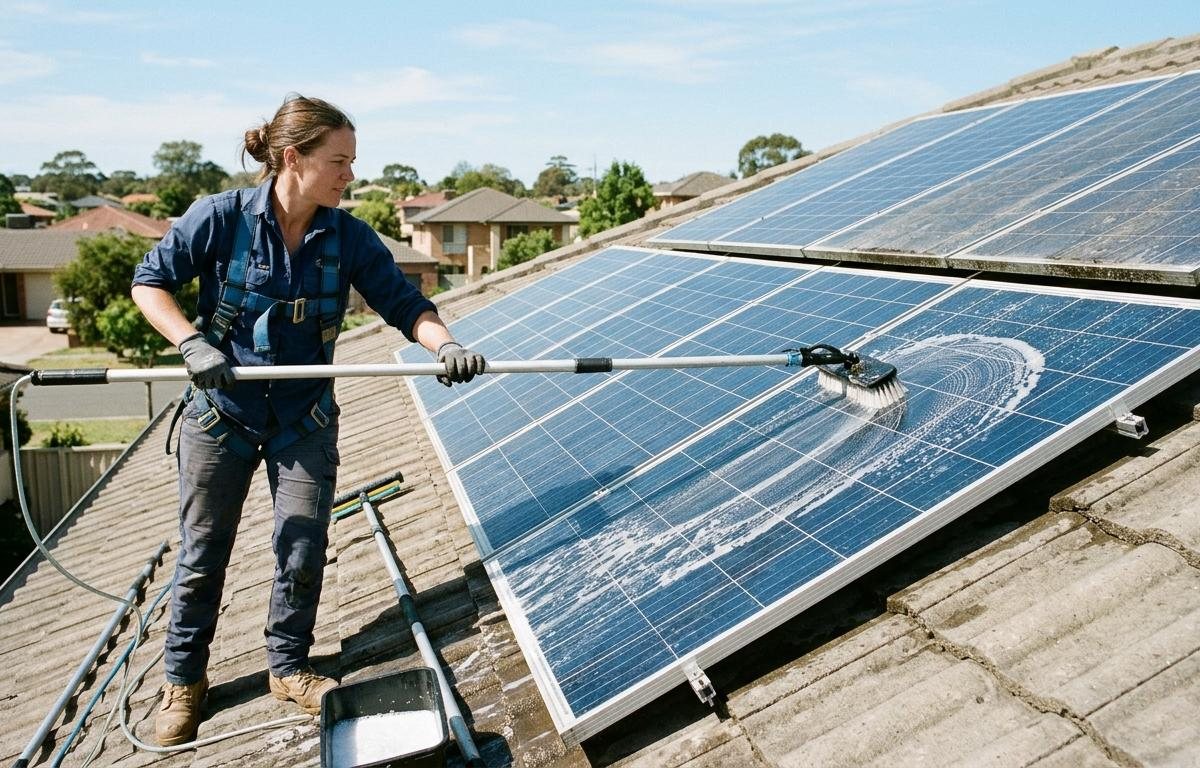
What Soap Residue Is and Why It Forms on Panels
Soap is built to cling. Its molecules grab onto oil and dirt so water can carry them away, but that same chemistry means a thin layer of surfactant tends to stay behind unless it gets rinsed completely. On a flat, tilted sheet of glass sitting in the sun, "completely" is a high bar. The film that remains is often invisible while the panel is wet and only shows itself once it dries.
Drying is where the trouble starts. Clean in hot, direct sun and the soap dries too quickly, leaving streaks and residue before a rinse can finish the job. Panels run hot, so even a mild afternoon can act like a hot one on the glass. The faster the water leaves, the more of the dissolved soap stays put.
Tap water adds a second problem. Dissolved minerals dry into spots and haze of their own, and they bond with soap scum to form a tougher film. That is why the soap-and-garden-hose routine, which feels harmless, can leave a panel looking worse than it did before.
Household products were never formulated with solar glass in mind. Dish soap in particular can leave a residue that doesn't rinse away easily, and industry guidance is consistent on the point: see this pro tip on never using soap to clean dirty solar panels. The soap residue on solar panels effects aren't dangerous in any dramatic sense. The issue is that a panel is a precision surface, and a cleaning agent that doesn't fully leave it becomes a new kind of dirt.
How Soap Film Affects Output, Soiling and Coatings
The soap residue on solar panels effects fall into three connected categories: blocked light, attracted dirt and degraded protective surfaces.
Blocked light. A solar cell converts the light that reaches it, so anything sitting on the glass competes with production. A soap film is thin but uneven, and uneven films scatter and absorb light instead of letting it pass cleanly. Leftover soap leaves streaks, and the soap residue on solar panels effects include reduced efficiency. I won't put a precise percentage on the loss, because the commonly repeated figures trace back to secondary blog posts rather than primary measurements. The direction is well supported, though: a film on the glass cuts the light reaching the cells, and a clean panel doesn't have that problem.
Attracted dirt. Owners notice this effect least and pay for it most. Residue left by soap is sticky, so it pulls in dust and pollen and makes the panels dirty faster. A panel washed with soap can look good for a few days and then foul more quickly than one that was never washed at all. The film acts like flypaper for airborne particles, so the cleaning meant to restore output sets up faster re-soiling instead. For more on how soiling builds up and robs production, this explainer on why dirty panels silently drain your energy covers the broader picture.
Degraded coatings. Most solar panels carry specialized coatings, such as anti-reflective or hydrophobic layers, designed to boost efficiency and repel water and dust. Aggressive or repeated chemical contact puts those layers at risk, and damage to the glass or the anti-reflective coating can significantly hurt performance over time. The same logic applies to tools: abrasive scrubbing wears the same surface that detergents can cloud.
There's a practical side too. Manufacturers typically specify approved cleaning methods, and using unlisted agents like household dish soap can put warranty coverage at risk. Check the panel manual before you settle on a method.
How to Spot Soap Film on Your Panels
Soap film can hide while panels are wet, so inspect when they're completely dry and the light is low, in early morning or late afternoon. Stand at an angle to the array rather than looking straight on, and watch how light plays across the glass.
Signs worth looking for:
- Streaks and swirl marks that follow the direction of a hose spray or a wipe, especially near the lower edge where runoff collects.
- A cloudy or rainbow-like haze that shifts color as your viewing angle changes.
- Patchy dust clusters, where dirt gathers in some areas and not others because sticky residue is holding it in place.
- Water that beads unevenly when you lightly mist a small test area, sheeting in some spots and clinging in others. Healthy glass sheds water fairly uniformly, so irregular behavior suggests something is sitting on it.
Compare a suspect panel with one that has been rinsed only with pure water, or with a section you know was never washed with soap. Side by side, the difference in clarity is often obvious. If your inverter's monitoring data shows output sagging after a wash instead of recovering, soap residue on solar panels effects are one of the first things to suspect.
One caution: don't try to fix a suspected film by scrubbing harder or adding another round of cleaner. More agents and more friction make both problems worse. The right response is a gentle, residue-free rinse, ideally from someone who does this regularly. If you're weighing who should handle it, our guide to finding licensed solar panel cleaners explains what credentials and insurance to look for.
Why a Chemical-Free Pure Water Rinse Avoids Residue
If soap is the source of the film, the cleanest fix is to leave it out entirely. That's the principle behind a chemical-free pure water system, and it's how Best Solar Panel Cleaning approaches every job in Stockton.
Pure water, in this context, means water with the dissolved mineral ions removed. Deionized water has those ions stripped out, so when it dries there's nothing left to leave spots. Ordinary tap water behaves very differently. Dissolved calcium and other minerals stay behind as the water evaporates, which is why a hosed-down panel can look spotted within an hour. Even rainwater, despite its reputation for cleanliness, carries enough dissolved material to leave marks that can reduce performance.
With no soap and no minerals, a pure water rinse dissolves and carries away dirt without depositing anything new. The panel is left with nothing on it except the coatings the manufacturer put there. That protects the anti-reflective and hydrophobic layers, avoids the sticky surface that attracts fresh dust, and sidesteps the warranty questions that come with unapproved agents. It's also safer for the surrounding roof, landscaping and runoff, since nothing harmful washes off the array and into the drainage.
For readers curious about the water itself, we compare the two common purified options in deionized vs distilled water for solar panels. And if streaking is your main concern, cleaning solar panels without streaks walks through technique in more detail.
Stockton Conditions, Scheduling and Warranty Protection for Residential and Commercial Owners
Stockton's setting shapes how panels get dirty and when they're best cleaned. Dry summers, agricultural dust drifting in from surrounding fields, seasonal pollen and the occasional smoke or ash event all leave a steady layer on glass. That constant supply of fine particles is exactly what a sticky soap film captures, so the soap residue on solar panels effects in this climate can lock in dirt even faster than they might elsewhere. After smoke season, ash needs its own careful handling, which we cover in wildfire ash removal from solar panels in Stockton.
Timing matters as much as method. Hot, sunny conditions make water and any residue dry too fast, so cleaning during the cooler hours gives the rinse time to work and keeps streaks from forming. Early morning is generally the safest window, and a licensed technician who sticks to that schedule also avoids the thermal stress of spraying cool water on a hot panel. Best Solar Panel Cleaning operates around the clock, which makes it easier to book those cooler windows instead of squeezing a job into the middle of an afternoon.
For residential owners, the stakes are a household investment and the manufacturer's coverage that comes with it. A method that stays within approved practice, with no soaps, detergents or abrasive tools, keeps that coverage on solid ground. For commercial owners the same logic scales. Large arrays amplify both the production lost to residue and the cost of correcting a bad cleaning, so a residue-free process protects output across every row and keeps documentation simple if a warranty question ever comes up.
Our technicians are licensed and insured, which matters when work happens on rooftops and around live electrical equipment. If you suspect a previous wash left a film behind, or you just want a clean that adds nothing to the glass, Best Solar Panel Cleaning can restore your panels with pure water alone.